

Let me guess – you’ve heard the phrase “spiritual leader” and immediately pictured yourself delivering sermons at the dinner table while your family stares blankly at their cold mashed potatoes.
Yeah, that’s not what this is about.
Spiritual leadership at home isn’t about being a preacher, a saint, or someone who has all the answers. It’s about something far more practical: leading your family with intention, values, and genuine care for who they’re becoming – not just what they’re achieving.
And here’s the thing: you’re probably already doing parts of this. You just haven’t named it.
What Spiritual Leadership Actually Means
Let’s strip away the religious jargon for a moment.
At its core, spiritual leadership is about guiding your family toward what matters most. It’s setting the moral and emotional tone of your home. It’s being intentional about the values you want to pass on – and then actually living them out.
According to Focus on the Family, a husband who wants to fulfill spiritual servant-leadership should: imitate Christ’s example, have integrity, provide grace and encouragement, look for ways to help each family member grow, and take proactive steps to protect his family’s mental, emotional, and spiritual health.
Notice what’s not on that list? Being perfect. Having a theology degree. Never struggling or doubting.
The bar isn’t perfection. The bar is showing up with intention.

Why Your Presence Matters More Than You Think
Here’s something the research makes crystal clear: fathers have a unique and irreplaceable impact on their children’s development.
Studies show that father involvement during childhood is significantly associated with children’s positive mental, cognitive, social, and physical outcomes. A meta-analysis on father involvement found links to children’s psychological adjustment, fewer behavioral problems, higher educational attainment, and better overall mental health.
But here’s the key finding: research confirms that children need more than just a father’s physical presence for the most optimal outcomes. The quality of the relationship matters enormously.
In other words, it’s not about being there. It’s about how you’re there.
Research from the Institute for Research on Poverty found that fathers tend to encourage children to explore, take chances, overcome obstacles, be braver, and stand up for themselves. Mothers typically emphasize different things – avoiding risk and injury, for example. Both are valuable. But your unique contribution as a father isn’t replaceable by anyone else.
The Servant Leader Model
If you want a framework for how to lead at home, look no further than the concept of servant leadership.
The idea, first articulated by Robert Greenleaf, flips traditional leadership on its head: good leaders serve first. They prioritize the growth and wellbeing of those they lead, not their own power or status.
A Delphi study on servant leadership identified 12 primary characteristics: valuing people, humility, listening, trust, caring, integrity, service, empowering, serving others’ needs before your own, collaboration, love, and learning.
Sound like a tall order? It is. But applied to family life, it becomes surprisingly practical.
What Servant Leadership Looks Like at Home
Let me paint a picture.
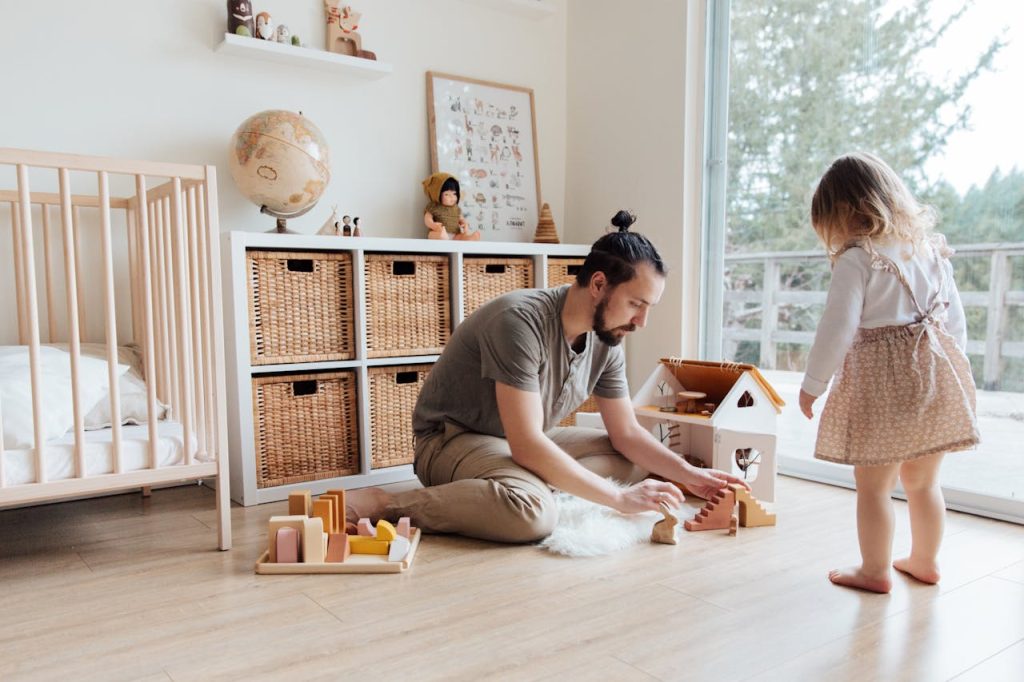
It looks like listening before solving. When your wife or child comes to you with a problem, your first instinct might be to fix it. Servant leadership means pausing, asking questions, and truly hearing them before jumping into solution mode.
It looks like admitting when you’re wrong. According to one resource on servant leadership in the home, a husband who admits when he’s wrong and apologizes to his wife and children teaches humility in action. It shows that true leadership is not about pride but about growth.
It looks like showing up when you’re tired. Think about a father who comes home exhausted from work but still takes time to read to his children or help with household tasks. That’s servant leadership in action.
It looks like prioritizing their development over your convenience. Are you investing in who your children are becoming? Are you asking about their inner world, not just their grades and activities?
It looks like protecting without controlling. There’s a difference between creating a safe environment for your family and micromanaging their every move. One builds trust; the other destroys it.
Values: The Foundation of Everything
Here’s where the “spiritual” part comes in – whether you’re religious or not.
Every family operates on values, whether they’ve named them or not. The question is: are you leading with intention around what those values are?
Research on parenting shows that parents tend to transmit values to their children, and those values shape everything from academic outcomes to relationship patterns later in life. The values you live – not just the ones you talk about – become the operating system for your home.
So what do you actually stand for?
Maybe it’s honesty – even when it’s uncomfortable. Maybe it’s kindness – especially to people who can’t do anything for you. Maybe it’s resilience – getting back up when life knocks you down. Maybe it’s faith – however you define that.
Whatever your values are, spiritual leadership means being intentional about naming them, modeling them, and creating an environment where they can take root.
The Obstacle of Inadequacy
Let’s be honest about something: most men feel completely unqualified for this.
According to research from Lifeway, many men don’t lead their families spiritually because they’re intimidated. The blank look on so many men’s faces asks: “What would I even do?”
If that’s you, you’re not alone. A 2019 Barna study found that 82% of young adults believe we’re experiencing a leadership crisis. Only 21% of young adults involved in churches report having access to leadership training. The gap between expectation and equipping is real.
But here’s the encouraging part: you don’t need to be an expert. You just need to be present and willing to grow.
As one writer puts it, if all you do is read a short passage of meaningful text and offer a short reflection or prayer, you’ve made a statement about what matters in your home. That daily declaration will form your children over the years and set the tone for your family.
Practical Starting Points
If you’re wondering where to begin, here are some concrete steps:
Create space for conversation. Whether it’s dinner without phones, a weekly check-in, or bedtime conversations – create predictable moments where real connection can happen. Your kids need to know they can talk to you about anything.
Model what you want to see. Want your kids to be honest? Be honest – including about your struggles and failures. Want them to be kind? Let them see you being kind to strangers, to their mother, to yourself. What you model is direction, not perfection.
Ask better questions. Instead of “How was school?” try “What was the hardest part of your day?” or “What made you laugh today?” Show genuine curiosity about their inner world.
Take responsibility for your own growth. You can’t lead anyone where you haven’t gone yourself. Are you reading? Reflecting? Working on your own character? Your growth gives you credibility to guide theirs.
Be consistent. Showing up once doesn’t build trust. Showing up consistently, over years, does. Spiritual leadership is a marathon, not a sprint.

A Word on Humility
Here’s something that might surprise you: the most effective spiritual leaders aren’t the ones who have it all figured out. They’re the ones who are honest about their struggles while still pointing toward something better.
Research on servant leadership emphasizes that humility is essential. A servant leader is one who honors others, recognizes their lives as a stewardship, and redirects their ambitions into service.
Your kids don’t need a perfect father. They need a present one who’s trying – and who’s honest about the gap between who he is and who he wants to be.
That gap, handled with humility, actually becomes a teaching opportunity. They learn that growth is lifelong. That failure isn’t final. That character is built through struggle, not despite it.
The Bottom Line
Spiritual leadership at home isn’t about having all the answers. It’s about caring enough to guide your family toward what matters most – and humble enough to grow alongside them.
It’s about presence over performance. Values over achievements. Character over comfort.
You’re shaping the people your children will become. The values they’ll carry. The way they’ll treat their future partners and children. That’s not a small thing.
And you don’t have to do it perfectly. You just have to do it intentionally.
So start where you are. Lead with your values. Show up with your heart.
That’s spiritual leadership. And your family is waiting for it.

Tudor Cioaba is the founder of Masculinitism and a Senior UX Researcher who studies how people think, feel, and decide. He holds an MBA and is a certified NLP Practitioner and Life & Business Coach. After more than twelve years of personal inner work, he writes about healthy masculinity from lived experience, not theory: honest, practical, and free of hype.
Cu inima plină de recunoștință îți mulțumesc pentru timpul și energia ce le oferi pentru a transmite aceste articole!
Să primești putere de la Dumnezeu să continui și rasplata să o primești tot de la El!
Mulțumesc!
Cristina, multumesc din suflet pentru cuvintele astea frumoase si pline de caldura!
Ma bucur enorm ca articolele rezoneza cu tine si ca gasesti valoare in ceea ce impartasesc.
Si da, ma rog zilnic ca Dumnezeu sa-mi dea putere, claritate si indrumare sa continui sa scriu si sa transmit ceea ce simt ca trebuie transmis. Nu fac asta pentru recunoastere sau validare – o fac pentru ca simt ca e o chemare, o misiune pe care am primit-o.
Si sa stii ca si tu, prin faptul ca esti aici, ca citesti, ca pui intrebari profunde si ca imi scrii astfel de mesaje incurajatoare – ma ajuti enorm. Pentru ca imi arati ca ceea ce scriu ajunge la oameni care chiar cauta adevar si transformare.
Asa ca multumesc si eu tie – pentru deschidere, pentru sinceritate, pentru curaj sa te uiti la tine si sa cresti.
Sa ne ajute Dumnezeu pe toti sa devenim cea mai buna versiune a noastra si sa aducem lumina acolo unde e nevoie.
Cu recunostinta si apreciere,
Tudor 🙏